



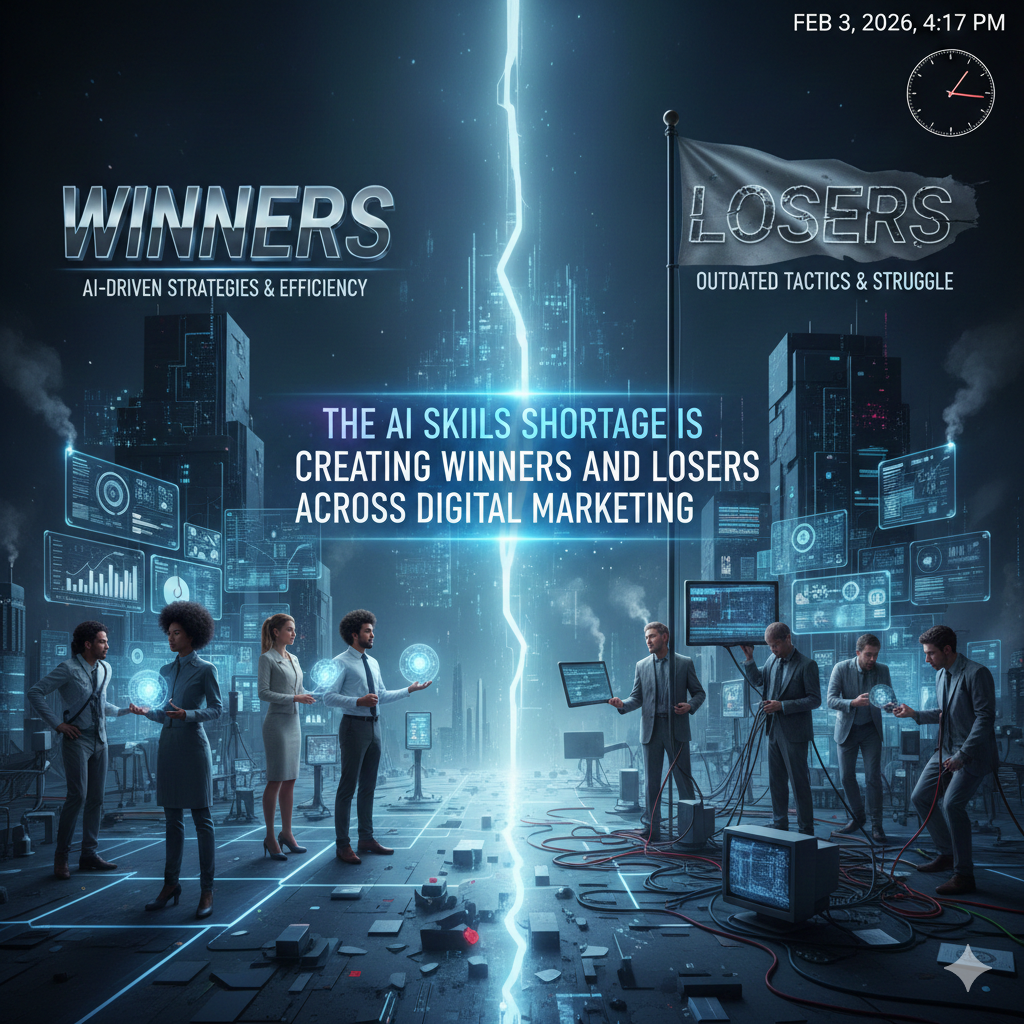
The gap between companies that understand how to use AI in marketing and those that are still figuring it out is widening. The difference lies not only in technology adoption, but also in whether organizations develop the human capabilities to make AI tools actually work.
Businesses across the UK and Ireland are beginning to realize that purchasing an AI subscription does not automatically lead to a competitive advantage. The tools are accessible. You don’t have the skills to use them effectively.
training issues
With the proliferation of AI tools, the digital training gap impacting businesses is becoming more apparent. A year ago, the question was whether to embrace AI. The question here is whether the team has the knowledge to use the adopted tools productively.
Marketing departments are in a unique situation. They have access to advanced AI capabilities but lack systematic training on implementation. Staff members experiment individually and develop ad hoc approaches that vary widely in effectiveness. Some people discover productive workflows. Some people waste their time on approaches that don’t help.
This contradiction causes organizational problems. If everyone has a different approach, your team won’t be able to share best practices. Managers cannot evaluate AI-assisted work unless they understand what is good. If implementation variation is too great to separate variables, companies cannot measure ROI.
The companies that lead the way aren’t necessarily the ones with the biggest budgets for AI. They’re investing in structured training to build consistent capabilities across the marketing department.
Transforming content creation
Nowhere is the skills gap more evident than in content creation. AI-generated content for SEO purposes has gone from experimental to mainstream, but its quality varies greatly depending on how humans direct and refine that content.
A simple approach of letting AI write articles and publishing them with minimal editing will produce content that search engines increasingly recognize and ignore. This sophisticated approach uses AI to ideate, plan, and enhance ideas while maintaining human oversight for strategy, precision, and quality.
Companies that understood this difference were early to build content operations that outperformed their competitors while maintaining quality standards. Companies that treated AI as a replacement for human judgment rather than an enhancement are now facing the consequences of lower rankings, less traffic, and content libraries full of non-functional material.
This lesson applies to more than just content creation. AI tools enhance existing capabilities rather than creating new ones from scratch. Organizations with a strong marketing foundation can benefit more from AI than those that expect AI to compensate for a weak foundation.
Search optimization evolves
Search engine optimization has changed more in the past 18 months than it has in the past five years. AI-powered SEO tools that are reshaping the industry have changed the way competitive analysis, keyword research, technical audits, and content optimization work.
The professionals who adapt the fastest have common characteristics. They understood SEO principles before AI tools existed, giving us context to evaluate AI recommendations. They approach new tools with a healthy dose of skepticism and test the output rather than accepting it uncritically. They continue to learn as tools evolve and recognize that today’s best practices change.
Less adaptable professionals find themselves surpassed by colleagues who have invested in AI literacy. The gap between high and low achievers has widened. Tasks that once required similar time investments are now significantly segregated based on tool proficiency.
The dynamics of agency have also changed. Clients are increasingly expecting AI-enhanced capabilities and are questioning agencies that aren’t adapting. The competitive environment favors organizations that invest in training over those that assume existing skills will be well maintained.
Winners are emerging
Patterns are emerging as to which organizations will benefit most from AI marketing tools.
Companies with existing marketing capabilities stand to benefit disproportionately. They have a framework for evaluating AI output and a strategic context to orient their AI tools. Their human expertise is augmented rather than replaced.
Companies that invest in systematic training build a sustainable advantage. Rather than relying on individual experimentation, develop organizational capabilities that persist even as staff change. New hires inherit a proven approach rather than starting from scratch.
Organizations that treat AI as a transformation rather than an addition will restructure their workflows around AI capabilities. They don’t just add AI to existing processes, they redesign processes to take advantage of what AI does best while retaining what humans do better.
Regional companies with strong fundamentals often outperform larger competitors with more resources but less focus. An agency in Belfast that systematically trained its team on AI tools was able to compete with an agency in London that assumed scale alone would ensure adaptation.
losers struggling
The pattern of failure is equally clear.
Companies hoping that AI would compensate for their weak marketing foundations have found that AI actually exacerbates the problem. Even if you execute a poor strategy faster, it’s still a poor strategy. Mass produced mediocre content is still mediocre content.
Organizations that purchased tools without investing in training are now stuck with expensive subscriptions with disappointing results. The tools work, but the humans using them don’t know how to make them work.
Companies with resistant cultures struggle to realize the benefits of AI, even when individual champions are present. Pockets of AI capability will not grow unless leadership supports adaptation. While competitors advance, organizations remain stuck.
Agencies are facing a decline in clients and have been slow to adapt. Businesses seeking an AI-enabled partner have options. Companies still using pre-AI approaches find themselves explaining why their competitors can deliver more.
What will change now?
The window to easily leverage AI has closed. At a time when AI literacy was rare, early adopters reaped the benefits. Today, AI capabilities are becoming more of a key factor than a differentiator.
This does not mean that investing in AI is no longer important. It implies an advantage-shifting nature. Merely having an AI tool is no longer enough to differentiate you. They can be effective if used skillfully.
Investing in training is becoming more important, not less. As the use of baseline AI expands, differentiation will come from depth of functionality rather than tool presence. Organizations that train more thoroughly and consistently perform better than those that don’t.
Sophistication of integration will become increasingly important. Basic AI usage is widely available. Connecting AI tools into a coherent system and compounding the benefits of each requires a more sophisticated understanding.
Human judgment remains essential. AI is better at execution than strategy. Organizations that maintain strong strategic capabilities while leveraging AI for execution outperform those that attempt to automate decisions.
way forward
For companies evaluating their position in this changing landscape, a few questions reveal just how much work lies ahead.
Does your team have consistent AI practices, or does everyone approach it differently? Consistency means systematic training. Variations suggest ad hoc adoption.
Can you measure the contribution of AI to your results? Or are you guessing? Measurement capabilities indicate that your implementation is mature. Uncertainty shows that we don’t yet understand what’s working.
Are your competitors ahead, stable, or lagging compared to you? Your market position will tell you whether your pace of adaptation is in line with the competitive environment.
Do you have a training roadmap or do you support individual tool releases? A roadmap indicates a strategic approach. The reaction shows a tactical scramble.
The answer will tell you whether you should accelerate your AI training investments, continue at your current pace, or shift your focus elsewhere.
The reality of competition
The AI marketing revolution is real, but it hasn’t unfolded as quickly as early hype suggested. The winner is not the one with the most AI tools. They are the people who developed the human ability to use AI tools effectively.
This reality should cause concern for organizations that assumed that technology adoption alone would ensure competitiveness. This should encourage those who have invested in training and development, even if the immediate benefits are not obvious.
The skills gap is widening. Companies on the other side of the gap have time to address it, but that window won’t stay open indefinitely. Organizations that build AI literacy now will define the competitive dynamics for years to come.
Those who are still waiting to see how AI marketing develops are already behind the curve. The question is not whether to act, but whether the action occurs quickly enough to matter.
Want to know more?

