



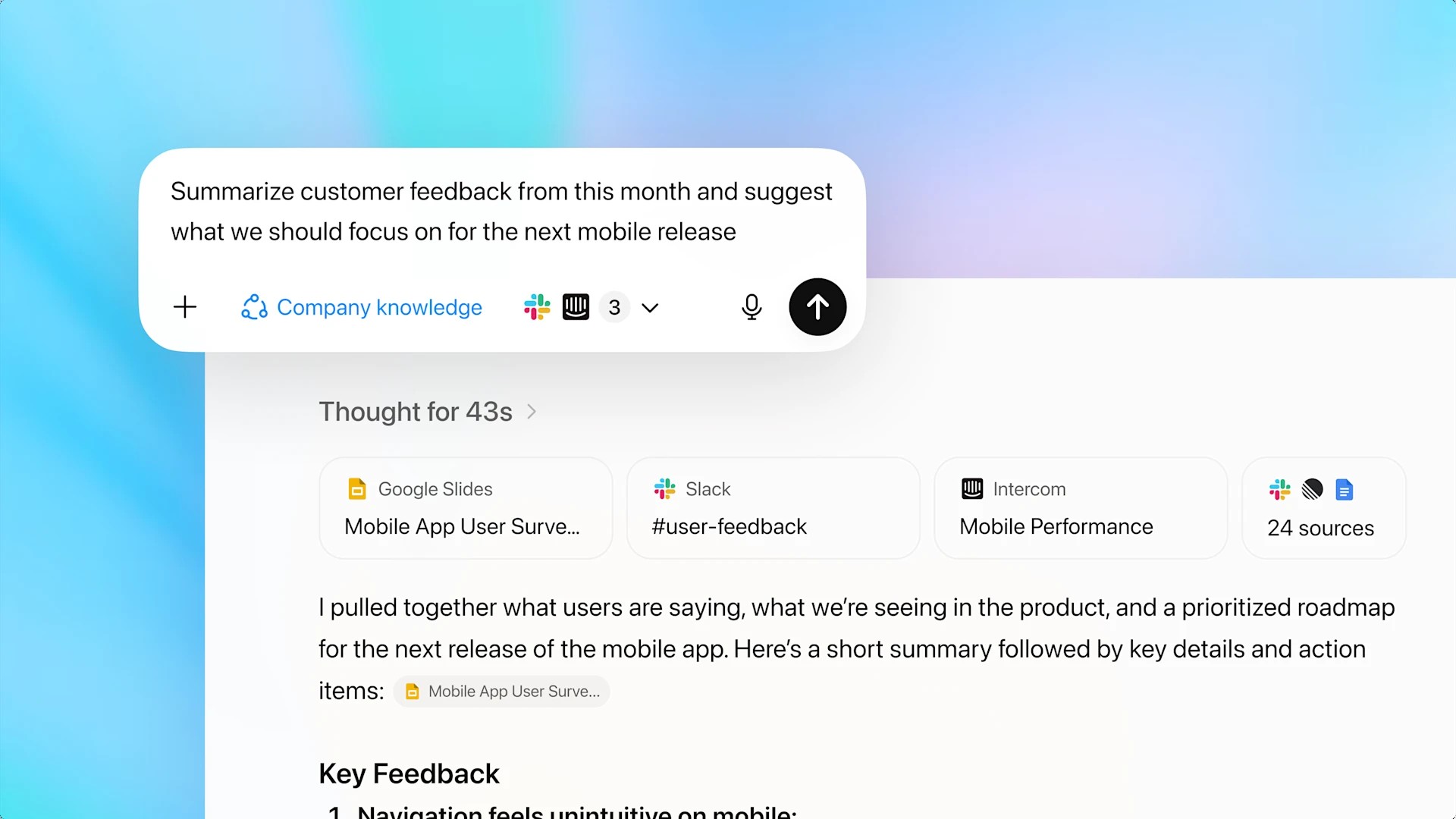
OpenAI connects ChatGPT to enterprise data and transforms it from a general assistant into a custom analyst to uncover enterprise knowledge.
For business leaders, the potential of generative AI has always been limited by the lack of access to internal data. Even the best AI is useless if it doesn’t have access to the information it needs to do its job. OpenAI points out that the information you need is often located in internal tools, but that knowledge is spread across documents, files, messages, emails, tickets, and project trackers.
This clutter is more than just an annoyance. Efficiency and decision-making suffer. The main problem is that these tools can’t always connect and the best answer is often spread across all tools.
This puts OpenAI against the AI strategies of large enterprise platforms such as Microsoft’s Azure, Office 365’s Copilot, Google’s Vertex AI, Salesforce’s Agentforce, and AWS Bedrock. Everyone is racing to connect models and protect enterprise data.
OpenAI uses third-party data for ChatGPT enterprise tasks
ChatGPT connects to apps like Slack, SharePoint, Google Drive, GitHub, and more. OpenAI says it is powered by a version of GPT-5 that is trained to check many sources to get better answers. For checking and verification, all answers indicate the source of the information.
This changes what can be done from simple description to complex analysis. For example, a manager preparing for a call with a client can ask for clarification. The model can then create summaries using recent Slack messages, email details, call notes from Google Docs, and support tickets from Intercom.
This power can also deal with chaos. When you ask, “What are the company’s goals for next year?” the tool summarizes what was discussed and points out differing opinions. It’s more than just finding data. He now analyzes situations and helps leaders spot disagreements and unfinished decisions.
Other uses for teams:
Strategy: Plan your roadmap by pulling together customer feedback from Slack, findings from Google Slides, and key topics from support tickets. Reports: Get data from HubSpot, summaries from Google Docs, and key takeaways from emails to create campaign summaries. Planning: Help engineering leads plan releases by seeing open tasks in GitHub, tickets in Linear, and bug reports in Slack.
Enterprise AI governance and adoption efforts
For CISOs and data leaders, sharing intellectual property with AI models is a big risk. OpenAI addresses this by focusing on administrative controls and data privacy.
The most important control is that the system respects the current company authority. OpenAI enables ChatGPT to only display enterprise data that each user can already see.
ChatGPT Enterprise and Edu administrators can manage access to apps and create custom roles. OpenAI states that it does not train data by default. It also includes security features such as encryption, SSO, SCIM, IP whitelisting, and compliance APIs for logging.
But technology leaders should know their limits. It’s not perfect yet. Users must select it when starting a conversation. There are also trade-offs. If Company Knowledge is turned on, ChatGPT will not be able to search the web or create charts. OpenAI is working to fix this issue soon.
A tool’s usefulness depends on its ecosystem. It started with major platforms and added connectors for tools like Asana, GitLab Issues, and ClickUp, copying the strategy of IBM watsonx and SAP Joule.
OpenAI’s enterprise data knowledge surfacing is the next step for AI assistants like ChatGPT, moving them into the private core of businesses. It attempts to solve the AI problem of connecting models to the data on which work is done.
For business leaders, this means:
Verify data: Before using this, CISOs and CDAOs should ensure that data permissions in SharePoint, Google Drive, etc. are correct. The AI only respects these permissions, so if the permissions are too open, the AI will expose its weaknesses. Pilot difficult tasks: Instead of rolling it out to everyone, find specific workflows that are slowed down by scattered information. Preparing client briefings and creating cross-functional reports are good places to start measuring results. Set expectations: Teams need to be aware of their limitations. The need to enable it manually and the inability to do web searches at the same time are major limitations to consider. Focus on the ecosystem. A tool’s value is determined by its integration. CIOs should compare the tool’s connector list to their own technology. Compare to your current platforms: See how we compare to AI solutions from Microsoft, Google, and Salesforce. Decisions are being made rapidly about which data ecosystem provides the most secure, integrated, and cost-effective path.
OpenAI’s new Enterprise Knowledge capabilities demonstrate that the most important thing for generative AI is not just how good the models are, but also secure and useful data integration.
This latest ChatGPT feature should break down enterprise knowledge silos and make work much faster, but it also makes data governance and access control more important than ever. For business leaders, this technology is not an easy solution. In fact, it’s a good reason to organize your data before others.
See: OpenAI Data Residency Advances Enterprise AI Governance

Want to learn more about AI and big data from industry leaders? Check out the AI & Big Data Expos in Amsterdam, California, and London. This comprehensive event is part of TechEx and co-located with other major technology events such as Cyber Security Expo. Click here for more information.
AI News is brought to you by TechForge Media. Learn about other upcoming enterprise technology events and webinars.

