



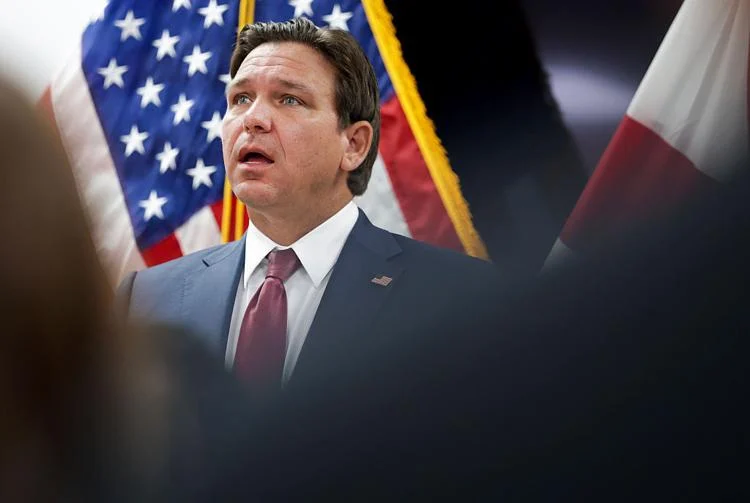
News Service of Florida — Gov. Ron DeSantis last week raised concerns about the potential “significant harm” from the growth of artificial intelligence and the need for state regulation.
But as Congress approaches the scheduled midway point of its regular session, only the Senate has moved on DeSantis’ desired “Artificial Intelligence Bill of Rights.”
The Senate’s efforts on an AI Bill of Rights, ranging from parental controls to limits on state agency contracts with certain foreign countries (SB 482), also await a final hearing in the Appropriations Committee.
But the House has not advanced a similar bill, despite Speaker Daniel Perez in December having committee leaders consider the “potential positive and negative impacts” of artificial intelligence ahead of the 2026 session.
The House version of the “AI Bill of Rights” (HB 1395) has been assigned to four committees, which has historically been a sign of leadership opposition to the proposal.
The delay in the House appears to be due to the need to balance Mr. DeSantis’ proposal with the federal government’s push for national regulations on AI that would constrain state laws.
President Donald Trump didn’t go that far when he issued a Dec. 11 directive requiring the U.S. Department of Justice to create an “AI Litigation Council” to review “onerous” state laws that don’t align with the White House’s position. States that don’t align could lose eligibility for funding meant to expand high-speed internet or face lawsuits.
Lawmakers therefore need to balance the intentions of the two Republican leaders.
Perez, a Miami Republican who has clashed with Mr. DeSantis on a number of issues over the past year, said in December that he disagreed with Mr. DeSantis’ approach to appearing to be at odds with the president.
“I don’t think technology in general, and national technology policy in particular, is something that the state should be involved in at the state level,” Perez told the News Service of Florida.
“Am I open to discussing AI, the good, the bad and the ugly? Absolutely, but the president’s opinion on AI and technology as a whole was approaching it from the perspective of national security and an executive order that has to address not only technology, but more importantly, the national security of this country,” Perez continued. “I don’t think we should deny or devalue the president’s views. I think that’s something that absolutely needs to be considered. And the House stands with the president in recognizing that technology is a national security issue that we need to think about and discuss, but we can’t deny it outright.”
Last week, DeSantis hosted a roundtable on artificial intelligence at the University of New Florida in Sarasota, emphasizing the nation’s responsibility to use technology to benefit people and enhance the human experience rather than replace it.
“This is being proposed and argued to be more than just something that will take us to the next level,” DeSantis said. “There are people who are very supportive of that. They almost revel in the fact that they think this is just going to replace humans and end up having AI run society and they won’t be able to control it. Don’t count me on that.”
Among his concerns are the use of chatbots to sexually groom teens and the impact of large data centers, which he claims will drive up electricity bills, increase local water demand and create few new jobs.
“If we see a sudden increase in demand, we’re going to make individuals pay more. It’s going to drive costs even higher,” DeSantis said. “And I don’t think anyone would want their utility bill to go up just because a chatbot is trying to corrupt a 13-year-old online.”
A proposal by Sen. Tom Leake (R-Ormond Beach) to create an “AI Bill of Rights” seeks to establish parents’ rights to control their children’s interactions with artificial intelligence. Humans have the right to know when they are communicating with humans, AI systems, and chatbots. It also establishes rules regarding the unauthorized use of people’s names, images, and likenesses.
The bill would also say people have a right to know whether political ads were created in whole or in part through the use of artificial intelligence and would prohibit Florida government agencies from contracting with AI companies with ties to so-called “foreign countries of concern” such as China and Russia.
Tom Mann, state policy manager for the Computer and Communications Industry Association, a national tech industry group, recommended to the Senate last month that Leake’s bill “would create a separate state framework that would increase compliance burdens without providing clear safety benefits.”

