



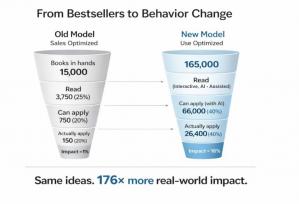
Same idea. When a book is designed to be used rather than just read, its real-world impact is 176 times greater.
Most business books sell, but behavior doesn’t change. Brian Cassady shows how AI shifts focus from sales to real-world use and impact.
— Brian Cassady
BRUSSELS, Belgium, January 16, 2026 /EINPresswire.com/ — Business books are everywhere: on airport shelves, in boardrooms, in conference favor bags. However, despite strong sales and awareness, many business books fail to change people’s actual behavior.
Brian Cassady, an innovation professor and AI strategist, says the problem isn’t a lack of interest or attention. That’s a design failure.
“Even at the top end of the market, a business book that sells 15,000 copies is already considered a bestseller, but typically only about 1% of readers will make meaningful use of it,” Cassady explains. “That gap is the real story.”
Traditional publishing optimizes for sales, achieving rankings, and gathering reviews. These metrics measure visibility, not influence. Books can sell well, get great reviews, and headline keynote speeches, but they rarely create lasting behavioral change.
This deficiency is often due to distractions and shortened attention spans. Cassady insists the explanation is incorrect. “The biggest declines don’t even occur at the time of purchase or reading,” he says. “It happens during use.”
Business books are still designed to be read linearly in work environments defined by interruptions, collaboration, and constant decision-making under constraints. They assume time, memory, and solo execution, conditions that modern jobs rarely provide.
Artificial intelligence reveals this flaw and enables a different model.
“AI didn’t make business books extinct; it changed the job.”
When working with AI, people don’t read cover to cover. Along the way, you query content, extract what’s relevant, test ideas against real-world constraints, and turn concepts into plans. In this context, business books become not static narrative artifacts, but infrastructures that serve as reference systems, thinking tools, and decision-making aids.
To test this change, Cassady stopped optimizing for bestseller rankings and began experimenting with a focus on usage and impact.
Free PDF version designed to work with AI tools
Links between e-book and print versions increase depth and durability
Book content embedded in an AI system that transforms ideas into tangible output
Success is measured in usage, not sales.
The goal is simple. The goal is to increase real-world applications by an order of magnitude. Early results suggest that this model can generate nearly 200 times more applied impact than the traditional product-as-a-book approach.
AI-powered business book impact model
From visibility to usability. How AI turns business books into applied systems
Cassady argues that free access does not diminish the value of expertise. That gives it wings.
“Even if ideas are free, weak ideas quickly fall apart when usage is visible. Strong frameworks prevail because they help people do real work.”
Once AI reduces distribution costs to near zero, the value shifts to applications. In this model, books cease to be products. This is an impressive product.
Cassady believes this signals broader changes to come. The most valuable business books of the next decade may not be sold in the traditional sense. Instead, they function like open systems that are free at the core, modular, AI-queryable, and supported by printed materials, services, and deeper engagement.
“AI did not create an execution gap,” Cassady said. “It just can’t be ignored anymore.” “In the future, AI will no longer be independent, but will be part of a package that delivers impact.”
Business books are now faced with a choice.
Please read. Or used.
About Brian Cassady
Brian Cassady is a professor of innovation, an AI strategist, and the author of two award-winning business books on innovation and AI. He works with executives on practical AI implementation and decision-making and has founded multiple companies in Europe and beyond.
contact
bryan.s@bryancassady.com
https://www.linkedin.com/in/bryancassady/
https://www.bryancassady.com
link
Get Brian’s award-winning book for free: CYCLES + The Generative Organization
Full media kit: http://tiny.cc/Book-Model-Press-Kit
Brian Cassady
GenOrg.ai
+32 475 86 07 57
please email here
Visit us on social media:
linkedin
Legal disclaimer:
EIN Presswire provides this news content “as is” without warranty of any kind. Our company does not assume any responsibility or liability
The accuracy, content, images, videos, licenses, completeness, legality, or reliability of the information contained herein;
article. If you have any complaints or copyright issues related to this article, kindly contact the author above.


