



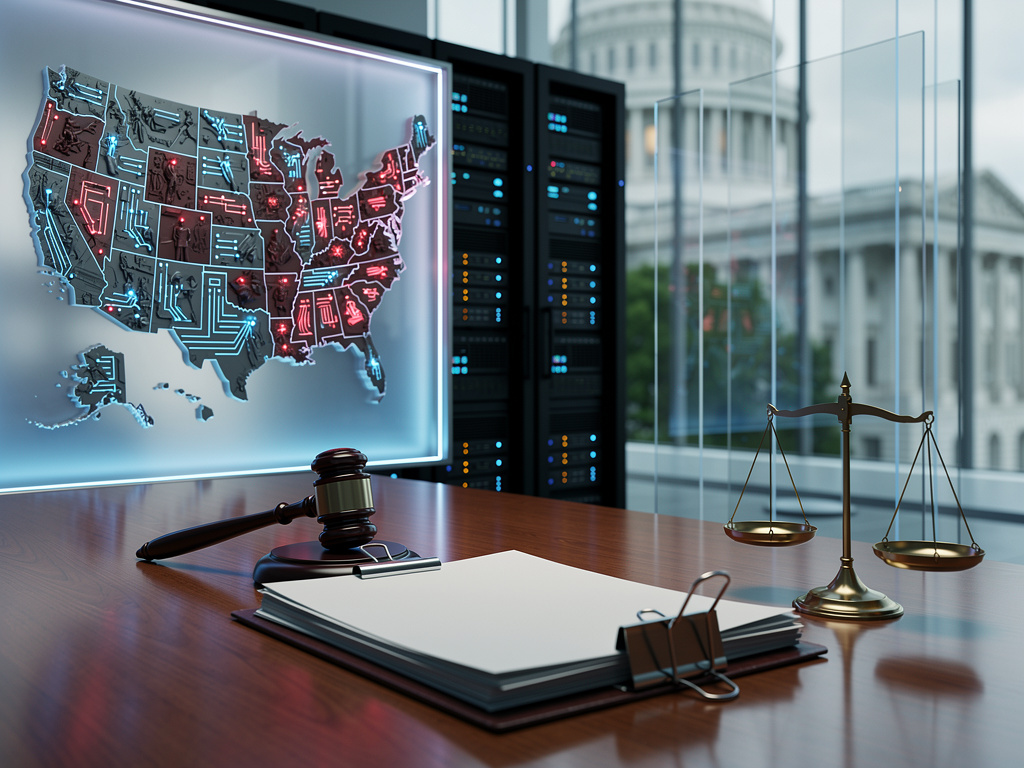
Trump’s AI Strategy: Developing a national strategy amid national rebellion and startup chaos
In a bold move that has rippled through the tech industry, President Donald Trump recently signed an executive order aimed at centralizing the regulation of artificial intelligence under a single federal framework. The directive aims to override various state-level regulations and promises to streamline oversight and foster AI innovation in the United States. But as legal issues mount and federal guidelines remain undefined, critics say they could plunge startups into a lengthy period of uncertainty. Based on recent news reports, the order targets what the administration views as burdensome state laws that impede technological progress.
The executive order, detailed in a TechCrunch analysis, creates a Justice Department task force dedicated to litigating state AI regulations deemed obstructive. The task force must begin work within 30 days, but the Commerce Department has 90 days to identify “onerous” state laws. The Trump administration has characterized this as a necessary step to prevent a patchwork of regulations that could curtail America’s dominance in AI, echoing industry leaders who have long called for uniformity.
But the order stops short of completely overriding existing state law, leaving businesses in a gray area. For example, California’s strong AI protections, which emphasize public safety and ethical implementation, could face pushback from the federal government. As The New York Times reported, President Trump described the initiative in an Oval Office briefing as creating “one federal regulatory framework,” but legal experts have questioned its enforceability without support from Congress.
Federal government overreach causes tensions between states
Threats to withhold federal funds, such as broadband allocations, from states that do not comply with the directive add further enforcement. According to Reuters, President Trump has made clear that states that impede AI progress risk losing such support, a tactic that has drawn harsh criticism from California Governor Gavin Newsom and others. Newsom’s office highlighted California’s leading role in AI, accounting for more than 15% of U.S. job openings and the majority of venture capital funding, according to the 2025 Stanford AI Index cited in the governor’s statement, and slammed the order as promoting “corruption rather than innovation.”
The impact of this funding is similar to past federal-state conflicts over environmental regulation. Industry insiders fear that startups, which often have low profit margins, will bear the brunt of future disputes. For example, a small AI company developing an algorithmic recruitment tool could be exposed to federal scrutiny simply by complying with Colorado’s anti-discrimination law, creating compliance issues and potentially discouraging investment.
Posts on X reflect a mix of optimism and skepticism among tech enthusiasts and entrepreneurs. Some have hailed the order as a deregulatory boon that could unleash innovation by dismantling what they see as outdated national barriers. Some warn that the promised “one rulebook” could turn into a legal battle, with smaller players sidelined while big tech companies lobby for favorable terms.
Legal hurdles and the path to the Supreme Court
Experts predict that the executive order will soon face constitutional challenges, especially because of federal preemption and interstate commerce. NPR reports that even some Republicans have expressed displeasure with the approach, viewing it as an overreach that could undermine states’ rights. The previously released draft text of the order proposes an AI litigation task force to argue that state laws unconstitutionally restrict cross-border commerce, a strategy that follows historical precedents such as the dormant Commerce Clause debate.
Colorado’s AI Act of 2024, which mandates safeguards against bias in employment and banking decision-making systems, is explicitly mentioned in the executive order. As detailed on Colorado Public Radio, the state’s measure is intended to protect consumers from discriminatory AI, but the federal directive labels it as “onerous.” Legal analysts at Law.com warn that without clear federal standards in place, the order could create more confusion than clarity and lead to a showdown at the Supreme Court.
For startups, this ambiguity leads to real-world risks. Venture capitalists may be hesitant to fund AI ventures amid regulatory flux, fearing that a compliant product today could be a liability tomorrow. One of the founders of a San Francisco-based AI analytics startup told reporters that uncertainty has already delayed funding rounds as investors seek clarity on compliance costs.
Big Tech influence and collaborative efforts
This order is not just about conflict. It also fosters collaboration between government, academia, and industry. A separate but related White House initiative outlined in CNN Business will allow Department of Energy labs to partner with tech companies on AI-driven scientific research, potentially accelerating breakthroughs in areas such as climate modeling and drug discovery. This aspect is a shift from Biden-era policies that emphasized ethical constraints and is consistent with President Trump’s broader agenda of prioritizing what the administration calls “human flourishing” over engineered societal challenges.
Influential figures like David Sachs, a Trump ally and tech investor, have publicly supported the move, arguing that it counters overregulation that hinders global competitiveness. But critics have pointed to potential corruption, accusing Newsom’s backlash in the Guardian of favoring Big Tech donors over the public interest. California’s dominance as home to giants like Google, Apple, and Nvidia positions it as a key battleground where state law fosters innovation while imposing guardrails.
When it comes to X, discussions often center on how it benefits existing players. While startups grapple with legal ambiguity, deep-pocketed companies could weather the disruption by influencing new federal regulations, potentially widening the gap between industry giants and emerging innovators, according to the post.
Startup survival strategies in uncertain times
Amid a regulatory tug-of-war, startups are adapting by diversifying their operations across states and even internationally to reduce risk. Rather than relying on executive legislation, some are lobbying for federal legislation that would bring the uniformity promised by President Trump. Industry groups such as the Chamber of Commerce echoed calls for Congress to intervene, warning that prolonged litigation could dampen investment in AI, which is expected to contribute trillions of dollars to the global economy by 2030.
As noted in various X posts, the order’s focus on lifting Biden’s restrictions is intended to unleash innovation by overhauling all previous AI policies. This includes removing barriers to open source AI development, which could strengthen the competitiveness of small and medium-sized enterprises. But in the absence of specific federal guidelines, experts are concerned about a vacuum in which unethical practices, from biased algorithms to data privacy violations, can flourish.
For example, a New York-based AI startup specializing in financial technology reported at an industry forum that it is currently consulting with lawyers to evaluate dual compliance paths and is experiencing a 20% increase in operational costs. This scenario highlights broader concerns. Although the order targets “American advantages,” it could inadvertently give foreign competitors an advantage in more stable regulatory environments such as the European Union.
Broader implications for innovation and policy
Looking forward, this executive order could reshape how AI is managed and set a precedent for emerging technologies such as quantum computing. If successful, it could prompt similar federal intervention in areas such as data privacy and self-driving cars. But if they lose in court, states could double down on regulations and the market could become even more fragmented.
Tech industry leaders are divided. Some, inspired by President Trump’s vision, see this as a catalyst for rapid progress that could make the United States the undisputed leader in AI. Based on historical regulatory struggles, some predict a long process of draining resources from actual innovation.
Recent X sentiment has tilted toward cautious optimism among entrepreneurs, with many posting about the need for balanced federal regulations that protect without paralyzing progress. As one user framed it, this order could either unify the field or trap innovators in a limbo of litigation.
Navigating the path forward for tech entrepreneurs
As the dust settles, startups will need to prioritize agility. Working on policy advocacy and building flexible AI systems that can adapt to evolving rules is key. Collaboration with academic institutions, enhanced by the Order’s research initiatives, provides legitimacy and a path to funding.
Ultimately, the legacy of this order will depend on whether it delivers on its promised “one rulebook” or merely prolongs discord. With lawsuits looming and states like California also pushing back, the coming months will test the resilience of the U.S. AI ecosystem.
Industry officials have suggested monitoring Congress’s reaction, as bipartisan displeasure could lead to the legislation being defeated. For now, the directive is a high-stakes gamble for federal supremacy, and startups are caught in the crossfire as they try to innovate amid uncertainty.

