



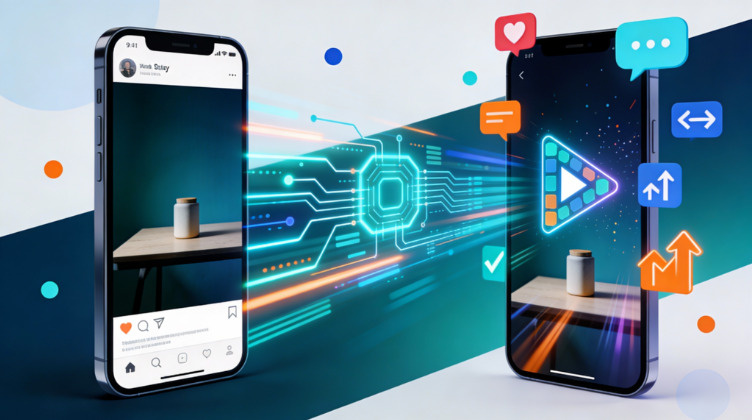
Almost every new trend on social platforms today is driven by short, highly visual content, with AI quietly doing much of the heavy lifting behind the scenes. The 2026 Social Media Trends report highlights the convergence of three forces: the dominance of short-form video, the mainstreaming of AI-generated content, and a focus on personalization and experimentation.
Short-form videos still dominate feeds
The 2026 social media outlook agrees that video is “still king” and that short-form formats like TikTok, Reels, and Shorts continue to dominate attention and ad spend. The predictions also highlight the split between multiple discovery paths, including algorithmic feeds, AI-powered assistants, and short-form recommendations that surface content before users search.
The trend report in the video highlights some of the hottest formats.
Short video series and recurring formats rather than one-shot clips.
AI-generated B-roll and motion graphics are layered over the talking head content.
“Trend Hopping” videos where creators quickly remix current memes, audio, and visual styles.
All of these point to the same pressure. Creators and brands need more videos, more often, without a proportional increase in editing time.
AI-generated content goes mainstream
Social media trend analysis for 2026 specifically points to AI-generated content as a mainstream reality, rather than an experimental edge case. Brands and creators use AI to generate scripts, images, B-roll, and even avatars to meet hectic posting schedules. At the same time, expert commentary warns that using AI for scale and variation while humans maintain the brand voice and strategy is key.
In video, AI is increasingly being used to:
Repurpose long-form videos into short, platform-optimized clips.
Turn reel/short static creatives (posts, photos, thumbnails) into movement based on trends.
Produce stylized visuals (cartoons, “toy” looks, surreal art) that captivate viewers in the first few seconds.
This is where Image to Video AI tools are at the heart of today’s social media hotspots.
Image to Video AI: From static posts to scroll-stop clips
For many creators, the easiest way to join the trend is to take existing assets like product shots, portraits, meme images, and illustrations and transform them into dynamic videos that fit current formats and audio. Image to Video AI systems do just that. Animate your photos with camera movements, transitions, effects, and sometimes audio and music to produce short clips in minutes instead of hours.
Arting’s Image to Video AI is positioned as a simple, login-free way to turn images and prompts into smooth, watermark-free videos, and use cases include social media marketing and education. It allows users to upload photos, illustrate motion and style, and download ready-to-post clips, perfect for quickly joining a trend or a visual upgrade to a static post.
VideoPlus’ Image to Video AI serves as a more comprehensive creation hub that combines image-to-video, text-to-video, reference-to-video, AI effects, and enhancements in one browser-based workflow. Its feature list explicitly cites “content creation and social media” as a core use case, with templates and tools designed to help users stand out on YouTube, TikTok, and Instagram.
AI-powered social media formats to watch
1. Reels and shorts that go beyond trends
The Video Trends Report highlights one specific behavior: “Video Trend Hopping.” Creators rapidly adopt new audio and visual styles and formats while they are still fresh. Image-to-Video AI helps transform existing brand and influencer images into trending clips without reshooting.
Arting’s Image to Video AI allows brands to animate product and lifestyle photos with subtle camera movements and on-brand effects, then sync them with trending audio within the app.
VideoPlus’ Image to Video AI allows creators to choose the aspect ratio (9:16, 1:1, 16:9), length, and motion amplitude, and layer them with AI video effects like “Emotion” and seasonal themes to match the trending vibe.
2. AI B-roll and visual filler
One of the video trends for 2026 is AI-generated B-roll. This is a supporting visual that plays over the narration or podcast clip. Instead of shooting custom footage, creators can generate an image sequence and animate it to create soft motion B-roll that matches their topic.
VideoPlus’ Image to Video AI provides AI image generation, image to video conversion, and video enhancement in one place, making it perfect for creating bulk B-roll for a variety of topics and series. Arting’s Image to Video AI gives small creators an easy way to turn mood boards, stock-like images, or AI art into smooth filler for reels and shorts.
3. Loop aesthetics and “core” videos
A popular social trend is the rise of aesthetic “core” content (cozycore, citycore, studycore) and looping mood videos that serve as ambient inspiration. These often begin as still photographs or collages and become short, looping videos with subtle movement, such as clouds, light, reflections, and camera drifts.
Image transformation tools allow you to transform static aesthetic boards into looping clips by adding gentle dolly movements, parallax, and light flickers. This allows users to take advantage of viral aesthetics without requiring new footage each time.
Creator workflow: from manual editing to AI-first
The outlook for social media and marketing highlights that AI is moving from experimentation to infrastructure. Rather than treating AI as a one-time trick, teams are building it into their standard content processes. In practice, that means:
AI-assisted ideation and scripting.
Image to Video AI, Text-to-Video, and AI B-roll tools accelerate visual production.
Automatic long-to-short reuse, plus AI-optimized scheduling.
VideoPlus’ Image to Video AI is tailored to this “pipeline” approach, allowing marketing managers, social media teams, and entrepreneurs to generate campaign videos, social content, and ads from images and text using commercial rights and industry-specific templates. Arting’s Image to Video AI fits early in the funnel, supporting rapid experimentation, concept testing, and quick posting from creators who need to move quickly with minimal setup.
Looking to the future: The next wave of social media
Predictions for 2026 suggest that social feeds will become more saturated with short-form videos, while AI-generated content and personalization will be enhanced. The winners will be creators and brands who use AI not only to produce more content, but also to:
Align your visuals with evolving trends faster than your competitors.
Maintains distinctive look and sound even at high volume outputs.
Convert any powerful images, including product photos, illustrations, and memes, into video variations on multiple platforms with Image to Video AI.
In that environment, tools like Arting and VideoPlus’ Image to Video AI are not new, but rather baseline capabilities, a way to keep up with the speed of culture without exhausting creative teams.

