



New Delhi: As artificial intelligence moves from labs and enterprise systems to everyday consumer platforms, the conversation is expanding beyond engineering to impact. AI is reshaping the way content is created, distributed, and consumed across industries, raising big questions about influence, access, and global competitiveness. The impact is particularly strong in India, which has one of the world’s largest digital audiences and a rapidly expanding creator economy.
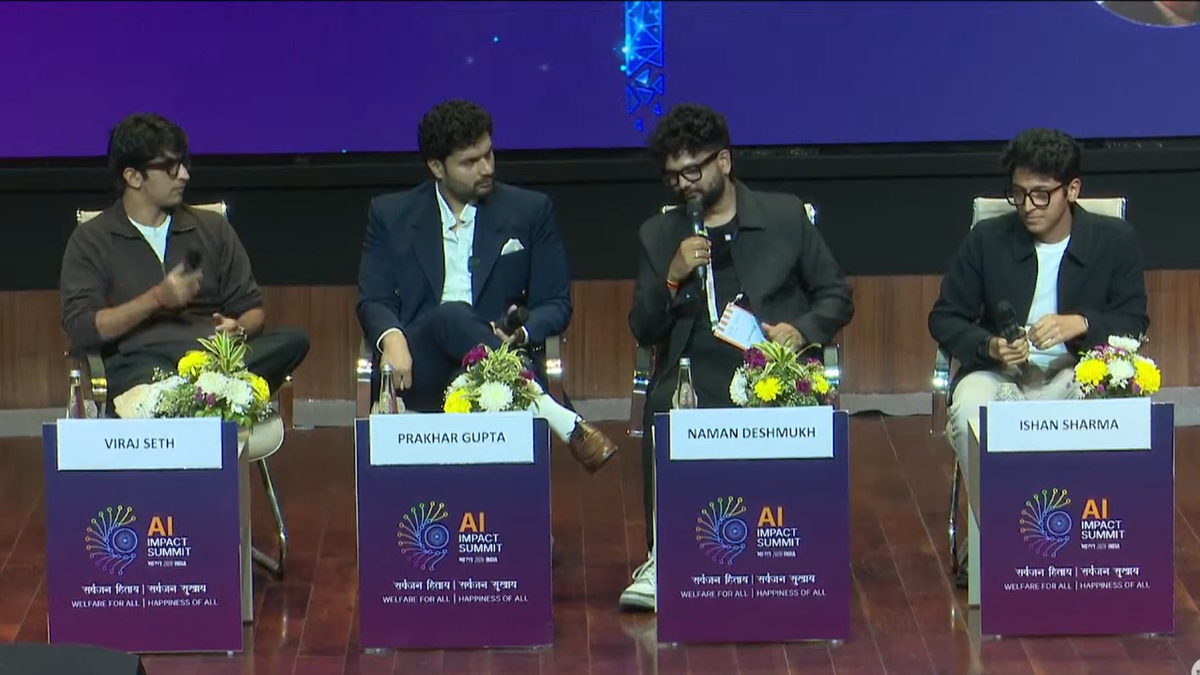
AI Impact Summit 2026 featured a wide-ranging discussion exploring how creators can use artificial intelligence to move from average to top 1%. The conversation moved beyond models and metrics to something more human: ambition, storytelling, and leverage. Moderated by Viraj Sheth, CEO of Monk Entertainment, the panel featured Prakhar Gupta, host of The Prakhar Gupta Xperience. Ishan Sharma, Entrepreneur and career-focused content creator. and technology and AI content creator Naman Deshmukh.
Sheth acknowledged that much of the summit focused on technical depth, positioning the panel at the intersection of technology and storytelling. The framework shifted when Mr. Gupta shifted his focus to where the real-world impact of AI would first unfold.
“The first place humans will interact with artificial intelligence will be in content,” he said, arguing that for most Indians, AI will not emerge through code or labs, but through Instagram Reels, chat interfaces, and media feeds.
India is one of the world’s largest content consumers and producers, Mr. Gupta said, adding that this scale is often not discussed. He suggested that what he called “ostensible gatekeeping” is rapidly disappearing as AI lowers traditional barriers such as accent, geography, and access to production.
“We need 10,000 people dedicated to Indian messaging and we can actually occupy the entire world’s communication channels,” he said. “At heart, it’s soft power.” For Gupta, AI is accelerating India’s ability to tell its own story at scale.
The discussion then turned to the rise of AI-generated influencer avatars, particularly “AI girls,” which are attracting massive engagement across short-form platforms.
“We have AI influencer girls who are getting billions of views. Instead of just reacting, we studied what works: the first three seconds, the hook, the structure. If that format works, let’s get the message across in that format,” Sharma said.
Rather than resisting this format, Sharma talked about reverse engineering it. He’s building automated systems that analyze past content, track what’s performing best in his field, scan audience comments, and monitor global conversations.
“AI is not Google search,” Sharma said. “It’s a collaborative partner. When you connect multiple tools and create workflows, you become like an agent. Every morning, you get insights tailored to your audience.”
Deshmukh added that surface-level stimulation does not create a lasting advantage.
“Most people are just using AI for surface-level outputs, but when you build systems on top of AI, there’s leverage there,” he said.
He revealed that parts of the proprietary content engine are automated, from analysis to optimization. He explained that he launched a fully automated, AI-driven Instagram page and within a few months had over 1 million followers.
“You wouldn’t believe it, but within four or five months, I had 1 million followers on my automated page,” he said, noting that most viewers don’t realize they aren’t physically present in the videos.
He explained that a custom-trained GPT model generates a script in his style, an avatar platform recreates his on-screen presence, a voice cloning tool refines the delivery, and an editor assembles the final output. What used to take days to prepare can now be done using an AI-assisted production pipeline.
As AI models continue to improve rapidly, the panel argued that technological access will become commoditized. The differentiators will move elsewhere.
“The model is only going to get better,” Deshmukh said. “We can build apps, avatars, songs, designs, but knowing what works, recognizing patterns, and applying preferences is the ultimate skill.”
Mr. Sharma reinforced this change in judgment. “In an age where you can create anything: avatars, apps, songs, designs, etc., knowing what works is the ultimate skill.”
Gupta extends the lens beyond content creation to cognition itself. He described assigning specific “characters” to the AI system for research, strategy, ideation, and even using it to design a personalized stretching routine after a long trip.
“There is nothing in this world that cannot be thoroughly investigated in 20 minutes with this tool,” he said. He also warned of saturation.
“In the next five years, so-called AI slop will dominate content consumption,” said Gupta. “Death centers driven by dopamine hacking will be dominated by artificial intelligence. Pattern recognition is something that AI is already better at than humans.”
He predicted that authenticity could gain value at the edge as AI-generated content floods the center.
“Mistakes are evidence of truth,” Mr. Gupta said. “If you don’t make mistakes, people will suspect it’s artificial intelligence. Imperfections indicate authenticity.”
Audience members voiced concerns about digital disruption, the strain on the ecosystem from data center expansion, and the lack of a clear governance framework. Although the panel did not delve into regulation, the exchange highlighted the growing tension between scale and sustainability.
Towards the end, Sheth recounted a brief exchange with a ride-hailing driver who asked him what AI actually meant, reminding him that adoption remains uneven across industries.
Expansion beyond tier-1 cities is important for Deshmukh. He spoke about training public school teachers on AI tools and observing noticeable changes in their classroom engagement. Mr. Gupta pointed to India’s demographic dividend, English proficiency, and skilled workforce as structural advantages. “The playing field has been leveled,” he said.
If there is a consistent message throughout the session, it is this: Access to AI tools is no longer an advantage. “Everyone has access to the same model. What separates you is the execution,” Deshmukh said.
In the race to move from average to the top 1%, the commission suggested that AI is a multiplier, not a finish line.

