



A ceremony was scheduled. CEOs were also on the guest list. And that didn’t happen.
On Thursday, U.S. President Donald Trump rescinded a planned AI executive order that had already been postponed multiple times, citing concerns that it could undermine U.S. competitiveness vis-à-vis China.
“We’re leading China, we’re leading everyone, and we don’t want to do anything that gets in the way of that lead,” Trump told reporters in the Oval Office. What he didn’t say was that the order had been effectively killed off by the very industry it was supposed to oversee.
I lobbied overnight.
According to Semaphore, which first reported the story, the White House’s plan was halted after xAI’s Elon Musk, Meta CEO Mark Zuckerberg, and venture capitalist David Sachs, until recently Trump’s AI and crypto czar, met directly with Trump between Wednesday night and Thursday morning.
U.S. media, citing sources, said the allegations were made against “accelerationist” factions within the administration, including officials at the National Economic Council and staff in the vice president’s office.
The order itself was not a comprehensive regulatory framework. It would establish a voluntary mechanism for AI developers to work with federal agencies to submit advanced models for security review up to 90 days before publication. There is no licensing system. There is no mandatory holding period. It’s voluntary.
That was clearly still too much. Trump said he delayed the meeting “because I didn’t like certain aspects,” without specifying specific aspects. He added that he was concerned that AI “could be an obstacle.” These are striking words from a president who has made AI a priority for jobs and national security.
vacuum with consequences
The US has yet to pass a comprehensive AI bill. What kind of governance architecture exists has been piecemeal through executive orders, agency guidance, and voluntary agreements. Earlier this month, the federal AI Standards and Innovation Center announced evaluation agreements with Google DeepMind, Microsoft, and xAI that will allow the government to evaluate models before making them available to the public. That program will continue regardless of Thursday’s non-signing.
But the bigger picture is regulatory change. In early March, the Trump administration announced a national AI legislative framework, calling on Congress to pre-empt state-level AI laws that “impose an unreasonable burden” and insisting on a single national standard for what it called “50 contradictory laws.” Congress has not acted on this basis.
The contrast with China is stark and increasingly difficult to ignore. In May, the Beijing State Council released the 2026 Legislative Work Plan outlining plans to accelerate comprehensive AI legislation, introducing language on AI governance in a formal planning document for the first time. For the third consecutive year, the National People’s Congress has put AI-related bills under consideration.
In April, the Chinese government issued new rules requiring AI companies to establish internal ethics review committees. China is writing the rules. Washington has canceled the ceremony.
Who Shapes U.S. AI Policy?
Thursday’s episode revealed something that had been implicitly in existence for months. Under the current administration, de facto veto power over AI regulation is vested in a small number of industry leaders with direct access to the president.
Musk, whose xAI is a direct competitor to OpenAI and Anthropic, has a structural interest in keeping the regulatory space open. Zuckerberg’s meta has similarly established himself as a champion of open source AI development. Despite officially stepping down as White House adviser in March, Sachs clearly retains enough influence to shape executive action.
Separately, Semafor reports that OpenAI has secured White House support for a parallel effort to push for AI regulation at the state level, an interesting gambit given that President Trump’s previous executive orders threatened states that had enacted AI laws that his administration disliked. The administration’s seeming support for a state-level strategy for OpenAI while reining in state regulation suggests that the problem of policy consistency runs deeper than a single signature delay.
Chinese frames actually work, but in both directions
President Trump’s stated reason for the withdrawal is to protect America’s lead over China, the same logic that has driven every major AI policy decision since his return to office, from the H200 export licensing framework to the Stargate infrastructure program. The logic is that China is watching closely.
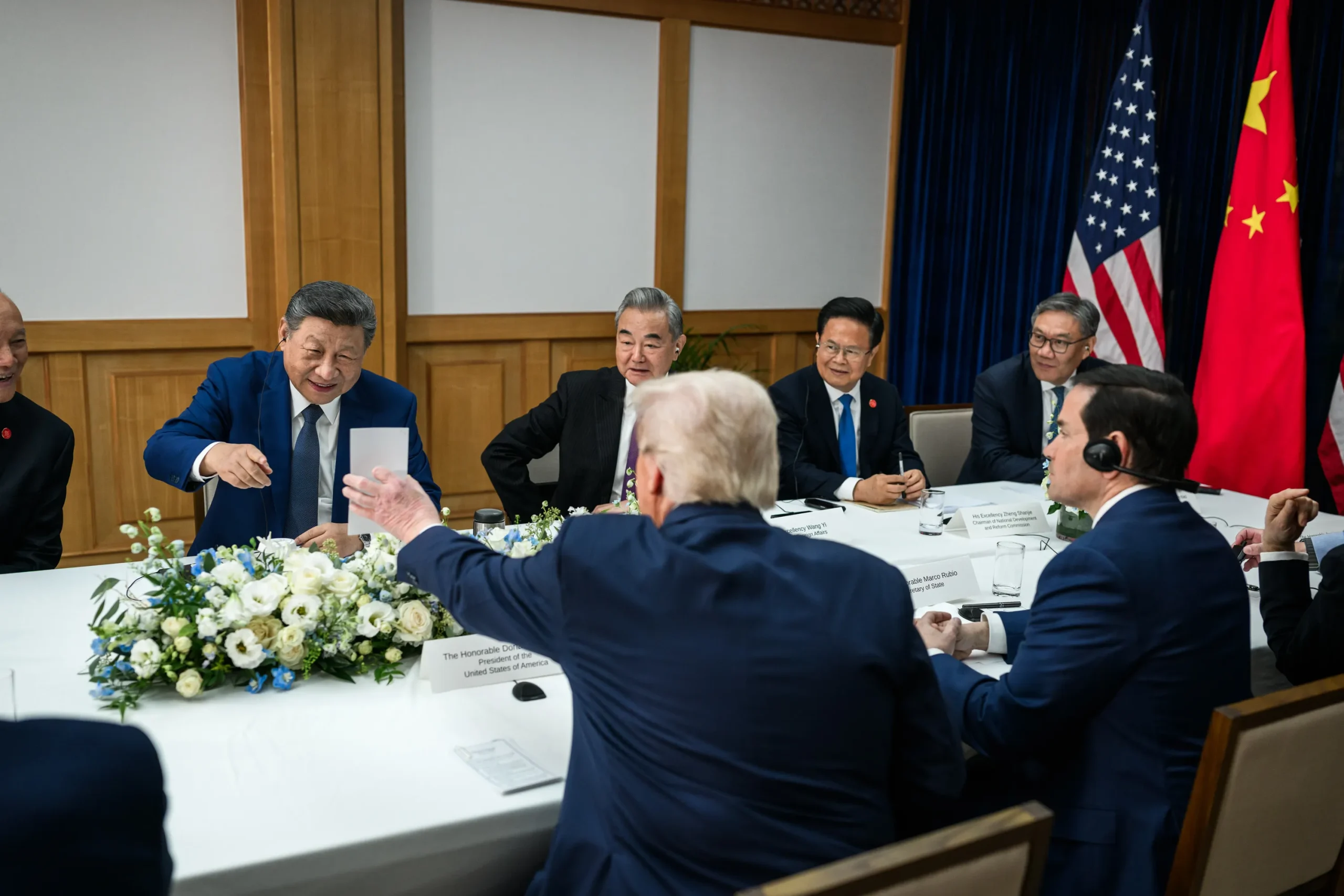
According to China’s Ministry of Foreign Affairs, at the Trump-Xi summit in Beijing earlier this month, the two leaders agreed to start an intergovernmental dialogue on AI. Beijing will note that the debate within the US government over even voluntary AI surveillance was resolved not by policymakers but by the companies that stand to benefit most from the absence of guardrails.
In a report for the South China Morning Post, Lizzie C. Li, a fellow at the Asia Social Policy Institute’s Center for China Analysis, noted that both the United States and China are grappling with the same fundamental question of where the regulatory frontier should be for frontier AI, especially as models become more autonomous and more relevant to cybersecurity.
“I think another, potentially more important competition is around governance and safety. It’s not about who has the most advanced model, it’s about who can manage powerful AI without hindering innovation,” she said.
The same report highlights what Kyle Chan of the Brookings Institution said more simply: “AI can be secured and regulated in a way that does not sacrifice innovation.”
Neither argument was strong enough Thursday. Even if there is a next time, it is still unclear whether the next time will be sufficient.
(Photo provided by: White House)
SEE ALSO: US-China AI gap narrows amid concerns about responsible AI
Want to learn more about AI and big data from industry leaders? Check out the AI & Big Data Expos in Amsterdam, California, and London. This comprehensive event is part of TechEx and co-located with other major technology events. Click here for more information.
AI News is brought to you by TechForge Media. Learn about other upcoming enterprise technology events and webinars.

