




Generative AI is moving from an experimental tool to the core infrastructure of the creator economy, but consumer enthusiasm is dampening as social feeds become flooded with “AI slop,” according to new research from Muse, Billion Dollar Boy’s innovation division.
The Muse report, which surveyed 4,000 consumers, 1,000 creators and 1,000 marketers in the US and UK, found that two years after AI emerged as a disruptive force, the gulf between industry optimism and audience acceptance is widening.
Spending surge defies consumer skepticism
Marketers have increased their ad spend on generated AI creator content by 79% in the past 12 months, and three-quarters plan to shift budget from traditional creator marketing to AI-generated content. Approximately 74% of marketers agree that AI-created content is more cost-effective than traditional approaches, with marketers in the U.S. investing significantly more than $1 million annually.
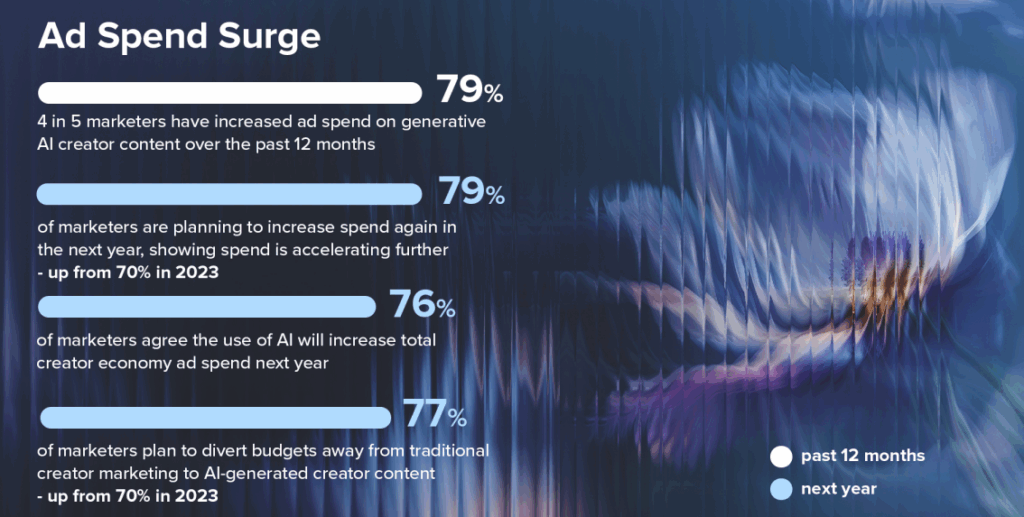
However, consumer preference for AI-generated creator content will plummet from 60% in 2023 to 26% in 2025, marking the end of the technology’s novelty phase. Opinions on AI’s role as a disruptor are divided: 31% are positive, 37% are negative, and 32% are unsure. This collapse reflects growing audience discrimination against low-quality and repetitive content, with 73% of marketers and 78% of creators believing that AI content “performs better,” while only 26% of consumers currently prefer AI content.
“Whether we like it or not, content is going digital. But AI isn’t a magic button you can just push and something great will happen. It’s a tool,” says Catherine Rasmussen, CMO at Pixelz. “And for that tool to work, you need really skilled people behind it, creative people.”
Creators embrace technology amid burnout concerns
Creators are showing stronger adoption patterns, with production of AI-generated content increasing by 87% over the past year. 79% report that AI has reduced their workload and 78% have increased their income potential. This technology is addressing burnout among creators, with 52% experiencing career-related fatigue and 37% considering leaving the profession. However, 62% are concerned about increased competition from virtual influencers and 59% are concerned about saturation of consumer feeds.
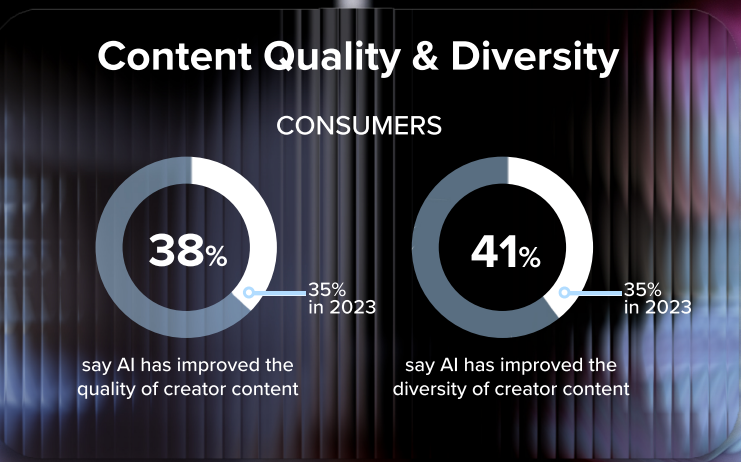
Consumer perception of content quality improved slightly, with 38% agreeing that AI has improved the quality of content from creators, up from 35% in 2023. Meanwhile, diversity awareness rose from 35% to 41%. The trend remains strong among experts, with 82% of creators and 77% of marketers agreeing that AI has improved quality. This improvement reflects more accessible production tools that improve creators’ baseline abilities and enable a broader range of storytelling unconstrained by traditional production limitations.
Platforms introduce safeguards as surveillance increases
Major platforms are introducing new safety measures as viewers come under increased scrutiny. YouTube is tightening its monetization rules to block mass-produced, low-effort formats while allowing original AI works. Pinterest labels AI-altered images and provides controls to limit the visibility of AI content. TikTok automatically labels AI-generated videos and requires creators to disclose realistic AI content. Meta is rolling out an “AI Info” label across its apps, but accuracy remains a challenge, and it’s also launching Vibes, a short-form AI video feed that signals the platform’s race to capture AI-native engagement.
Virtual influencers deliver results but face ethical issues
Virtual influencers (completely fictional AI personas) generate incredible consumer trust, with 76% trusting them to provide product recommendations and 68% trusting them to make purchasing decisions. However, success depends on intentional use and a clear purpose. H&M partnered with virtual influencer Kuki on the Innovation Metaverse Design Stories collection, resulting in an 11x increase in ad recall and a 91% reduction in cost per ad recall. Conversely, Vogue Magazine and Sheer Luxe faced backlash for featuring photorealistic virtual influencers, with critics arguing that the practice risked stealing human talent while perpetuating unrealistic beauty standards.
Digital twins respond to consumer resistance
Digital twins (AI-generated replicas of real creators) face significant skepticism from consumers, with just 31% of consumers supporting such partnerships and 57% believing the technology undermines trust. Despite audience resistance, 85% of creators are still open to creating digital twins with their brands for marketing purposes and see the technology as a potential for career sustainability. Fashion brands are pioneering the adoption, with H&M partnering with 30 models to create AI-generated digital twins, allowing them to retain ownership and licensing rights to their avatars. TikTok’s Symphony Digital Avatars allow creators and brands to deploy digital characters for 24/7 livestream sales, allowing brands to clone human streamers for around $1,000 with a few minutes of sample video.
Deepfakes and governance gaps raise alarm
Deepfakes (AI-powered impersonations created without consent) represent the dark side of technology, with 44% of marketers and 54% of creators recognizing deepfakes as a pervasive challenge that undermines trust. Among consumers, 65% say deepfakes have a negative impact on their trust in creators’ content, but less than half (45%) feel confident in identifying content created by AI. Celebrities such as Taylor Swift, Selena Gomez, Joe Rogan, and Elon Musk have had their portraits cloned in online scams. Beauty influencer Ariel Lorre discovered an Instagram ad for Korean skincare brand Skaind that featured an AI-generated replica of herself in a fake podcast interview.
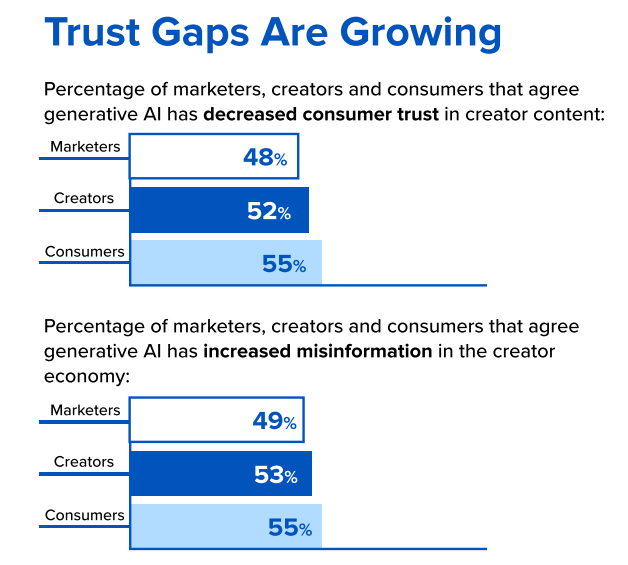
More than half of consumers (52%), creators (55%), and marketers (48%) agree that generative AI has decreased consumer trust in creator content, while a similar majority agree that AI has increased misinformation in the creator economy. When it comes to regulatory gaps, 60% of creators admit that their AI content violates industry regulations, 27% due to mislabeled or incorrectly labeled content, and 27% due to misinformation. Only 45% of marketers and 57% of creators agree that adequate intellectual property protection exists to prevent unauthorized use of creators’ faces and voices, and 58% of creators are interested in considering copyright protection.
“The problem is we can’t stop the flow of AI; technology is moving faster than regulation,” says YMU CEO Mary Bekait. “We will need to find ways to engage and not rely solely on platforms.”
Brands balance efficiency and creative expression
Diageo will increase the use of AI across its 2024 marketing campaigns to drive efficiency across its £2.7 billion ($3.7 billion) marketing budget, launching a virtual content studio to enable asset production for 34 major brands around the world. Rather than building an entirely new campaign concept, Diageo applies AI tools such as Pencil, Grip, CreativeX and Vizit to adapt existing creative and tweak backgrounds, lighting, local language and cultural nuances. From 2024 to 2025, the proportion of the budget spent on development or production will fall from 21% to 14%, and Diageo aims to bring this figure down to 10%.
A majority of marketers (82%) and creators (81%) agree that AI allows them to explore a wider range of creative concepts, and 77% of both groups agree that technology can help fight creative fatigue. Importantly, 77% of marketers and 78% of creators say AI has proven effective at creating content that resonates emotionally, and 80% of both groups agree that AI effectively interprets and captures brand personality. However, only 33% of consumers agree that generative AI effectively creates emotionally resonant marketing assets, while 27% disagree and 40% are unsure.
The study identifies a five-layer “AI content stack,” ranging from augmented AI-driven functional assets to experimental innovation labs where brands and creators test new formats. Successful strategies balance automation to boost volume, creators to add context, and emotional storytelling to differentiate, with some brands exploring “vibe marketing.” It’s AI-powered storytelling that captures your brand’s tone and vibe to combat creative fatigue and connect emotionally with your audience.
Creators’ trust in AI as a positive disruptor increased from 68% in 2023 to 73% in 2025. Meanwhile, marketer confidence declined slightly from 75% to 70%, but remained strong overall. This disconnect highlights the widening divide between professional and consumer consumers, as confidence in the industry remains strong but consumer sentiment cools and rifts appear.
Between June and July 2025, Billion Dollar Boy commissioned Census Wide to survey 4,000 nationally representative consumers (aged 16+), 1,000 content creators, and 1,000 senior marketing decision makers in the UK and US.
Image credit: Billion Dollar Boy
Full report available here

