



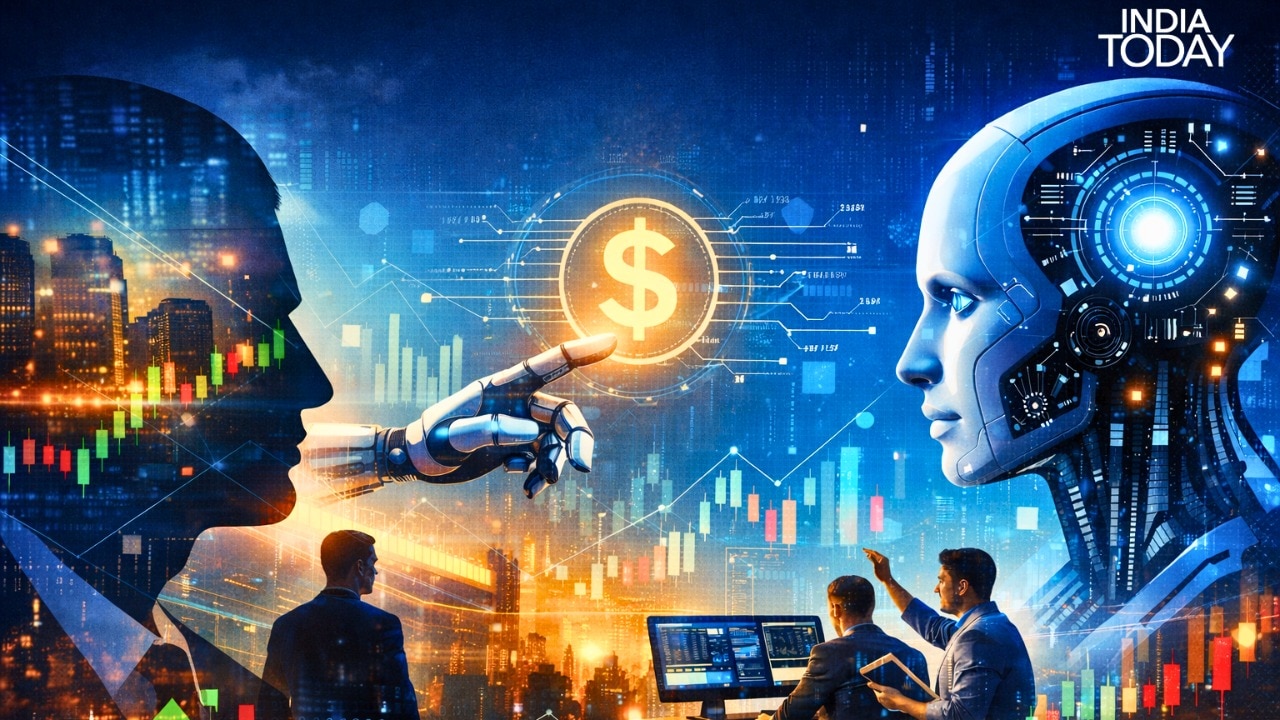
In every era of investing, there is a moment when the market realizes that the rules have changed. In the case of the dot-com boom, it was bandwidth. For smartphones, it was mobile data communication. In the case of cloud computing, it was subscription software.
Now, what determines this cycle is artificial intelligence, or AI.
AI is impacting the way companies hire, allocate costs, and plan for productivity improvements. The changes were visible even in the boardroom. However, it had not yet truly made its presence felt in the global stock market. That changed last week.
The impetus was the launch of the product in the United States. Anthropic, the AI company that developed the Claude model, has introduced tools that can create contracts, review compliance documents, and write software code. These are the core tasks of global IT services.
Investors were quick to react.
U.S. technology stocks have been volatile as markets reevaluate business models built around human expertise. The concern was not a drop in demand. It was about accelerating automation.
Dalal Street is also feeling the heat. Nifty IT has fallen about 8% in a week. Share prices of IT giants Infosys and Tata Consultancy Services (TCS) fell sharply. Nearly $50 billion in market value was wiped out.
Nothing collapsed. A crisis did not erupt. However, the market is starting to price in new possibilities. That AI could change the way value is created.
However, there are quiet questions underlying this decline. Is AI gradually changing the way we view investing?
AI-driven panic
The correction in IT stocks was not caused by weak earnings or macroeconomic shocks. This triggered a re-evaluation of future business models.
For decades, Indian IT companies have grown through a labor-intensive service model. Revenue is closely tied to the skilled engineers who build, maintain, and modernize enterprise software systems.
As complexity increases, billable hours also increase. More billable hours mean more revenue.
Advanced AI tools challenge that structure.
If you can automate or speed up some of the coding, testing, documentation, and integration, the revenue equation changes. Investors aren’t waiting for confirmation. They’re adjusting their expectations.
That’s what the market does when it senses a structural change.
But is AI really a threat?
The pessimistic argument is straightforward. As AI allows companies to build and manage software in-house with far less effort, external IT service providers and even some software companies may face erosion of their core models.
Taken to its extreme, this view suggests that traditional IT services may become structurally obsolete.
That fear caused prices to soar.
But that conclusion may be overstated, according to N. ArunaGiri, CEO of TrustLine Holdings.
“There are currently two starkly contrasting views on the impact of AI in the IT services and software sector,” he told IndiaToday.in.
“On the more pessimistic side, there is an argument that AI will allow companies to develop software in-house with significantly less effort; in its extreme, this suggests a structural erosion of traditional IT service and software providers.”
It’s a powerful story. But that may not be the most likely thing.
ArunaGiri believes a more balanced scenario would look different.
“AI has the potential to significantly compress the software development lifecycle. AI can significantly increase productivity by reducing coding time, reducing migration costs, and simplifying legacy modernization. Instead of shrinking demand, it may grow.”
Simply put, when something can be produced cheaper and faster, demand often increases.
Once-deferred projects can become viable as migration costs decrease and traditional upgrade costs decrease. Businesses may accelerate their digital transformation efforts. Time to market can be reduced. Productivity may increase.
That can cause what economists call second-order effects. Rather than shrinking demand, AI may enable a higher volume of software projects and integrated services.
reality check
The “software is dead” argument overlooks the complexity of the enterprise. Large companies operate across multiple countries. They manage legacy systems that are decades old. They operate in a highly regulated environment.
Many applications are mission critical. Failures in banking systems and communication networks are not minor glitches. This is a significant operational risk.
“These environments are unlikely to fully migrate to home-built AI-generated systems without expert oversight,” ArunaGiri says.
Specialist IT service providers will continue to play a role in integration, compliance, architectural design, and large-scale transformation. AI may aid development, but governance and accountability remain human-driven.
From today’s perspective, the more reasonable expectation is evolution rather than extinction.
Still, the nature of growth can change. Productivity gains from AI are inherently deflationary. As development accelerates, pricing power may decline. Trading volumes may increase, but profit margins may come under pressure. Growth rates are likely to be slower.
In the current correction, ArunaGiri advises against a universal push-buying approach. Investors should adopt a specialized lens on mid-cap IT stocks, especially those with lofty valuations that leave little room for error.
Explaining the role of AI in investment decisions
While some debates focus on whether AI will have a disruptive impact on businesses, other changes are occurring more quietly.
Artificial intelligence is entering investors’ toolkits. “AI may not change my investment decisions,” says Kunal V Parar, vice president, technology research and algos. “But it’s definitely changing my investment process.”
That distinction is important.
Investment decisions are ultimately based on conviction and capital allocation. The investment process is how the analysis is done.
A few years ago, valuing stocks meant manually examining valuation ratios like the price-to-earnings ratio, tracking technical indicators like the 200-day moving average, studying price structure and sector strength, and placing it all in a macroeconomic context.
These tools remain in effect.
What has changed is the depth of analysis.
Previously, backtesting strategies required spreadsheets and a lot of manual labor. It took time to compare multiple market scenarios. Responsibility for decision-making has always rested with the individual, but analytical bandwidth has been limited.
AI-powered tools can now scan a broader universe of stocks in seconds, simulate different market conditions, and analyze historical patterns more efficiently.
AI powers pattern recognition. Increases speed. Strengthen risk assessment.
However, it is not a substitute for judgment.
“AI can provide probabilities, but it cannot determine beliefs. It can optimize structures. It cannot replace accountability,” Parral explains.
What really determines your investment?
Investment decisions are determined by risk appetite, discipline, and psychological resilience.
AI can reveal statistical trends. It cannot measure confidence. It cannot absorb losses. Investors cannot decide how much risk to take.
This distinction will become even more important as AI tools become more widely accessible.
When everyone uses similar datasets and models, the information advantage narrows. Markets reward differentiated thinking, not identical processing.
Two investors can analyze the same AI-generated insights and come to completely different conclusions. The context is different. The strategic framework is different. Risk philosophies are different.
AI has the potential to standardize access to data. It does not standardize interpretation.
If everyone had AI, who would have an advantage?
There is a misconception that AI will eliminate human decision-making in investing. Investors will probably be divided into two groups. Those who rely blindly on automation and those who use technology as a structured assistant.
The first group is at risk of overdependence. The second person may be more disciplined.
Parra says AI is a partner in analytics. Allows for deeper exploration before taking a position. It helps stress test your hypotheses. Increase efficiency.
However, the final capital allocation decisions are still made by humans.
The recent decline in Nifty IT was the most notable swing. But the reassessment wasn’t limited to IT. Wealth managers, software providers, and other knowledge-driven companies were also feeling the pressure as investors began to recalculate what automation meant for margins, pricing power, and long-term growth.
That’s the bigger story.
Artificial intelligence is no longer just an enterprise productivity tool. It is becoming an evaluation variable. It is impacting how analysts model returns, how fund managers assess risk and how portfolios are constructed.
At the same time, AI is changing the way investing itself works. Analysis is faster. The scope of scenario testing goes even further. The data is deep.
What hasn’t changed is accountability. Capital is still allocated by human beliefs. Risk is still absorbed by human balance sheets. Interpretation still distinguishes between discipline and impulse.
AI has the potential to change the speed and structure of markets. But investing is still a human decision, made with sharper tools. Perhaps that is where this cycle truly differs from the last.
– end
Please tune in

